
Test Early, Test Often
The cost benefits of catching defects sooner

Welcome back to NextGen QA! In our previous articles, we’ve explored what testing is, the guiding principles, the difference between testing and debugging, and the psychology behind effective testing. Today, we’re tackling one of the most important concepts in software quality: when you test matters just as much as how you test.
This isn’t just theory — it’s economics. The timing of when you find and fix defects has a dramatic impact on cost, schedule, and product quality. Understanding this principle will change how you approach testing throughout your career.
Let’s explore why “test early, test often” isn’t just a catchy slogan — it’s a fundamental strategy for successful software development.
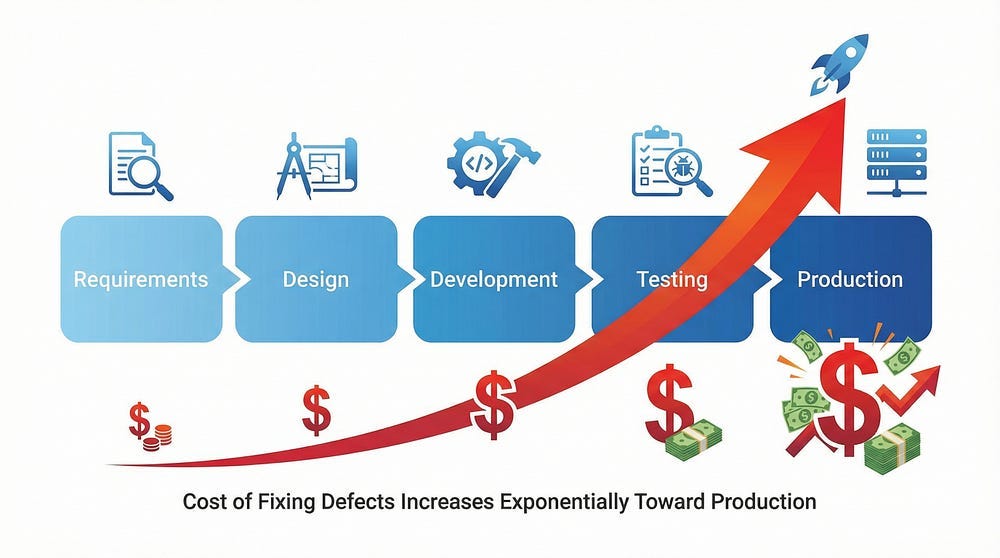
The Cost of Defects: A Financial Reality
Here’s a startling fact that every developer, tester, and project manager should know: the cost of fixing a defect increases exponentially the later it’s found in the development lifecycle.
Research consistently shows:
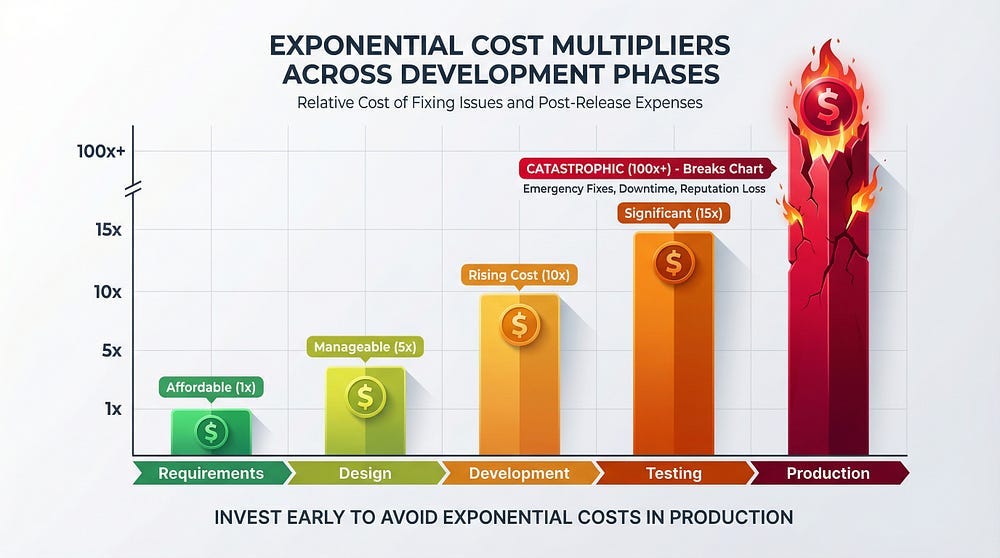
Requirements Phase: 1x cost (baseline)
Finding a defect during requirements review might take 15–30 minutes to fix
Simply updating documentation or clarifying specifications
Design Phase: 5–10x cost
May require redesigning architecture or data models
Multiple documents need updating
Team alignment needed
Development Phase: 10–15x cost
Code already written needs to be rewritten
Unit tests need updating
Integration points affected
Testing Phase: 15–40x cost
More code invested, more dependencies
Regression testing required
Documentation updates
Potential schedule delays
Production: 100–1000x cost or more
Emergency fixes and patches
Potential data corruption or loss
Customer support costs
Reputation damage
Possible legal liability
Lost revenue
Customer churn
Real-World Examples: When Late Detection Costs Everything
Let’s look at concrete examples of how late defect detection impacts real projects:
Example 1: The Banking Transfer Bug
The Defect: A requirements document specified that users could transfer “between $0.01 and $10,000” but didn’t define what happens with exactly $0.00.
If Caught in Requirements (Week 1):
Cost: 5 minutes to clarify and document
Impact: Zero
Actually Caught in Production (Month 6):
Thousands of $0.00 transfers clogged the system
Database filled with meaningless records
Performance degraded
Emergency hotfix required
Database cleanup script needed
Customer confusion and support tickets
Total Cost: $47,000 and 3 days of emergency work
The Lesson: A 5-minute requirements review question could have prevented a $47,000 problem.
Example 2: The Date Format Assumption
The Defect: Developer assumed all users would enter dates in MM/DD/YYYY format. No requirement specified format or validation.
If Caught in Design Review (Week 2):
Cost: 1 hour to specify format requirements
Add input validation to design specs
Impact: Minimal
Actually Caught by Users (Month 4):
European users entering DD/MM/YYYY caused data corruption
Historical data had mixed formats
Reports showed incorrect dates
Data migration script required
Customer trust eroded
Total Cost: $23,000 and 2 weeks of work
The Lesson: Design-phase thinking prevents development-phase disasters.
Example 3: The Missing Error Handling
The Defect: No requirements or design specified what happens when external API calls fail.
If Caught During Code Review (Week 5):
Cost: 2 hours to add proper error handling
Write a few tests
Impact: Minor
Actually Caught in Production (Launch Day):
Application crashed when payment gateway went down
No graceful degradation
Users lost cart data
Launch delayed
Emergency all-hands meeting
Rushed fix introduced new bugs
Total Cost: $156,000, delayed launch, damaged reputation
The Lesson: Code reviews and early testing catch missing scenarios before they become crises.
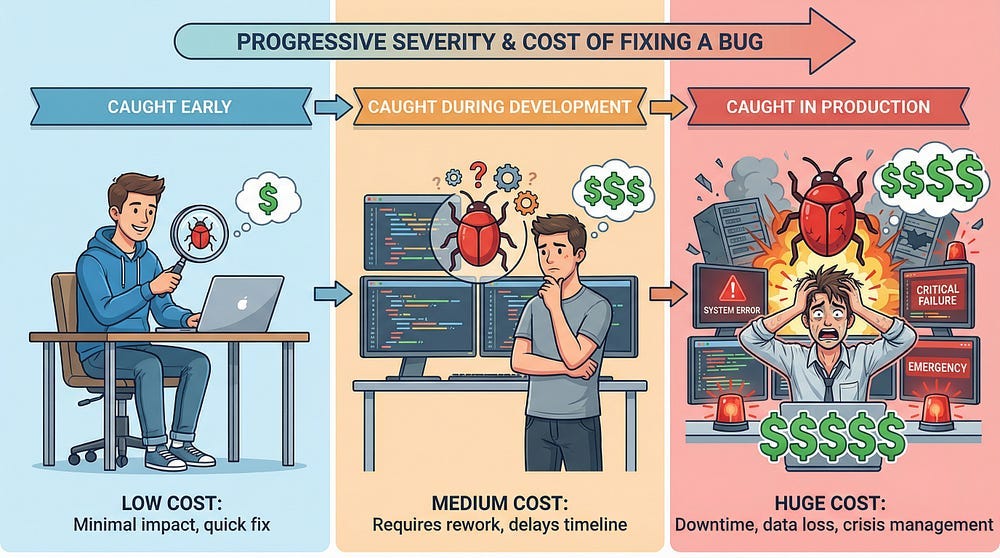
Why Early Detection Saves Money
Understanding why early detection is cheaper helps you advocate for it effectively:
1. Less Code Investment
Early in the project, less code exists. Changing requirements or design doesn’t require rewriting thousands of lines of code.
Example: Changing a database schema in design phase: 1 hour. Changing it after 50,000 lines of code depend on it: 2 weeks.
2. Fewer Dependencies
Early on, components aren’t tightly coupled yet. Changes don’t cascade through the entire system.
Example: Changing an API endpoint signature in design: update the spec. Changing it after 20 services consume it: update 20 services, coordinate deployments, manage versions.
3. Easier Communication
During requirements and design, the whole team is focused on planning. Discussions are expected and encouraged.
Example: Questioning a requirement in a planning meeting: normal collaboration. Questioning it 3 months into development: “Why didn’t you bring this up earlier?”
4. No Emergency Pressure
Early defects are found during calm planning phases. Production defects create panic, rushed fixes, and compounding errors.
Example: Designing proper error handling: thoughtful, tested, peer-reviewed. Emergency production fix: whatever stops the bleeding right now.
5. User Impact
Early defects affect only the development team. Production defects affect real users, causing frustration, lost trust, and potential business loss.
Example: Requirements defect: team discusses it over coffee. Production defect: angry users on social media, support tickets flooding in, executives asking questions.
What “Test Early” Actually Means
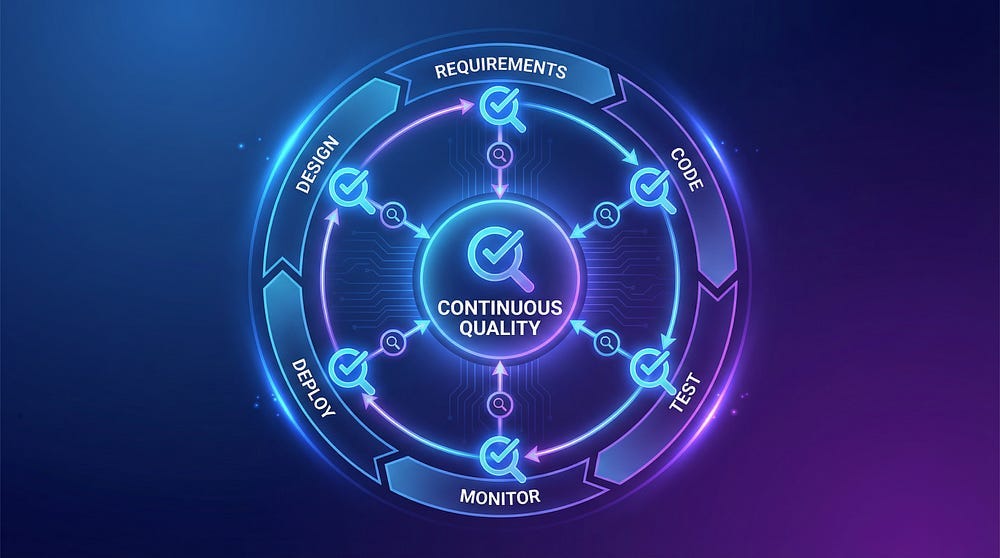
“Test early” doesn’t just mean “start test execution sooner.” It means involving testing thinking throughout the entire development lifecycle:
Testing During Requirements
What it looks like:
Reviewing requirements for completeness, clarity, and testability
Asking “how will we verify this?” for each requirement
Identifying ambiguities and missing scenarios
Ensuring requirements are actually testable
Questions testers ask:
“What defines success for this feature?”
“What should happen in error scenarios?”
“Are there any assumptions we’re making?”
“How will users actually use this?”
“What’s the acceptance criteria?”
Value provided:
Catch missing requirements before coding starts
Clarify vague specifications
Identify impossible or contradictory requirements
Ensure requirements address real user needs
Example: A requirement says “The system shall be fast.” A tester asks: “What does ‘fast’ mean? Page load under 2 seconds? API response under 500ms? Can we make this measurable?”
Testing During Design
What it looks like:
Reviewing architecture and design documents
Identifying potential integration issues
Considering testability in design decisions
Planning test data and test environments early
Questions testers ask:
“How will we test this integration point?”
“What happens if this external service is unavailable?”
“Can we simulate this in a test environment?”
“Are there security considerations we should test?”
“Will this design make automation difficult?”
Value provided:
Catch design flaws before implementation
Ensure designs are testable
Plan for test environments and data
Identify security and performance risks
Example: Design shows tight coupling between components. Tester asks: “If we need to test the payment module independently, how will we mock the user authentication dependency?”
Testing During Development
What it looks like:
Developers writing unit tests
Code reviews with quality focus
Continuous integration running automated tests
Exploratory testing of work-in-progress features
Questions testers ask:
“What edge cases did you consider?”
“How did you test error handling?”
“What happens with invalid inputs?”
“Did you test this on different browsers/devices?”
Value provided:
Find bugs before code is “done”
Ensure code meets quality standards
Catch integration issues early
Build test automation alongside features
Example: During code review, a tester notices no validation for negative numbers in an age field. Asks: “Should we add validation here?” Five-minute fix instead of a bug report later.
Testing During Deployment
What it looks like:
Smoke testing in staging environments
Verifying deployment scripts
Checking production monitoring
Ensuring rollback procedures work
Questions testers ask:
“Did the deployment succeed?”
“Are all services running?”
“Is monitoring working?”
“Can we roll back if needed?”
Value provided:
Catch deployment issues before they affect users
Verify production readiness
Ensure monitoring catches real issues
What “Test Often” Actually Means
Testing isn’t a one-time event — it’s a continuous activity:
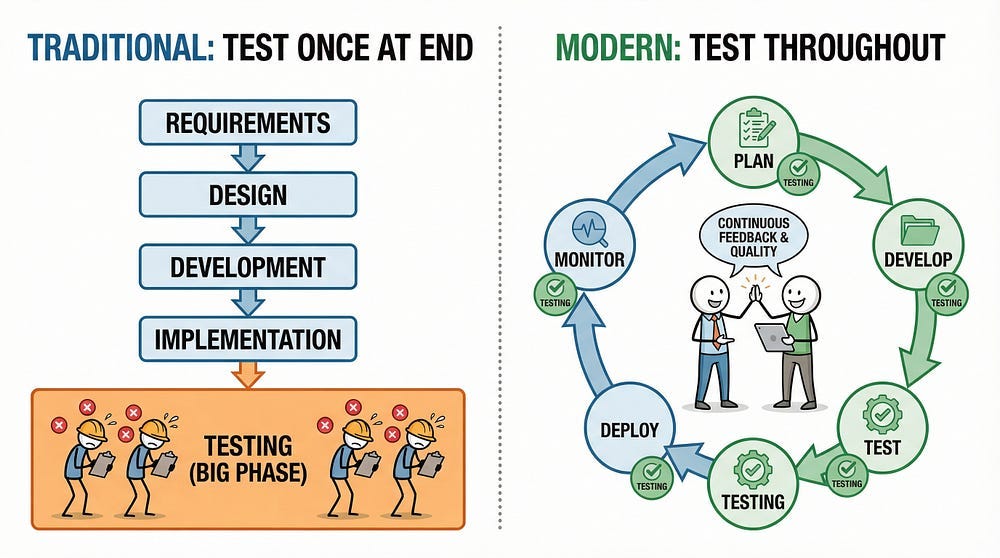
Continuous Testing in Modern Development
Traditional Approach (Don’t Do This):
Write all code for 6 weeks
Hand to testers
Find 200 bugs
Fix for 4 weeks
Test again
Still find bugs
Scramble to launch
Modern Approach (Do This):
Write feature incrementally
Test immediately
Fix issues same day
Deploy to staging
Test again
Deploy to production
Monitor
Repeat for next feature
Benefits of Testing Often
1. Faster Feedback
Developers get immediate feedback while context is fresh
Issues are easier to fix when recently written
Learning happens in real-time
2. Smaller Change Sets
Testing small changes is easier than testing everything at once
Pinpointing what caused a bug is simpler
Risk is lower per deployment
3. Reduced Integration Pain
Components integrate continuously, not all at once at the end
Integration issues surface immediately
No “big bang” integration nightmares
4. Better Quality
Quality is built in, not tested in
Problems don’t accumulate
Technical debt is minimized
5. Predictable Velocity
No surprise “testing phase” at the end revealing hundreds of bugs
Consistent progress throughout
More accurate estimates
The Shift-Left Movement
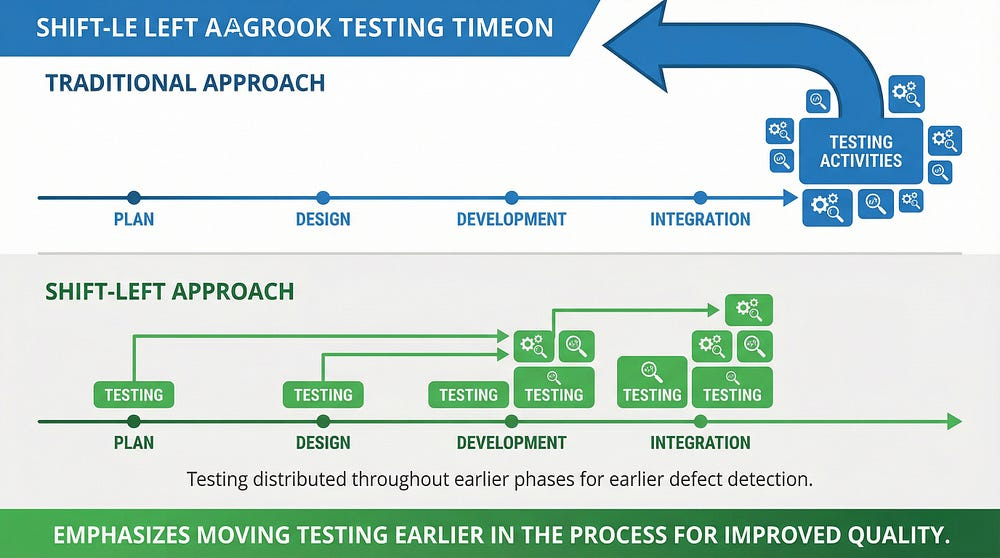
“Shift-left testing” means moving testing activities earlier (left) in the development timeline. It’s become a major trend in software development because of its proven cost benefits.
What Shift-Left Includes
1. Requirements Testing
Reviewing and validating requirements before development
Creating acceptance criteria upfront
Defining test scenarios during planning
2. Test-Driven Development (TDD)
Writing tests before writing code
Code is automatically testable
Design emerges from test thinking
3. Behavior-Driven Development (BDD)
Writing executable specifications
Collaboration between business, dev, and test
Shared understanding before coding
4. Continuous Integration/Continuous Deployment (CI/CD)
Automated testing on every code commit
Immediate feedback to developers
Quality gates prevent bad code from advancing
5. Static Analysis
Analyzing code without executing it
Finding potential bugs, security issues, code smells
Catching issues before they become defects
Proven Benefits of Shift-Left
Studies show that organizations practicing shift-left testing experience:
30–40% reduction in defects reaching production
40–50% reduction in overall development costs
50–60% faster time to market
Improved team collaboration and communication
Higher developer satisfaction (fewer emergency fixes)
Better product quality and customer satisfaction
The ROI of Early Testing: Real Numbers
Let’s put actual numbers to the principle:
Scenario: E-Commerce Checkout Feature
Project Details:
New checkout feature for online store
Team of 5 developers, 2 testers
12-week timeline
Expected to process $2M in transactions monthly
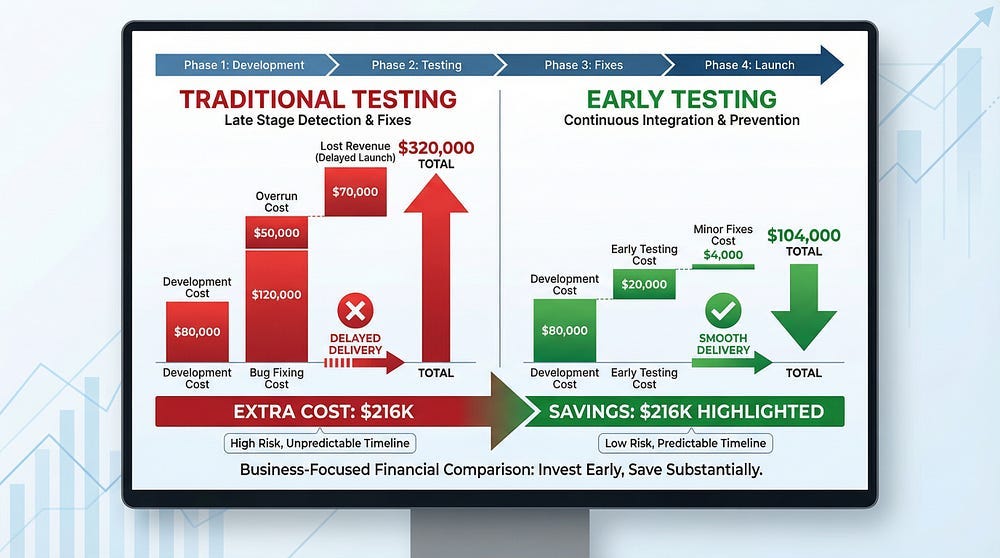
Approach A: Traditional Testing (Testing at End)
Week 1–10: Development Week 11–12: Testing
Results:
156 bugs found during testing phase
47 bugs were design/requirements issues requiring significant rework
4 additional weeks needed to fix and retest
18 bugs still found by users in first month
Cost overrun: $89,000
Revenue lost due to cart abandonment bugs: $127,000
Total additional cost: $216,000
Approach B: Early & Continuous Testing
Week 1: Requirements review with testers Week 2–12: Development with continuous testing
Results:
31 potential issues identified during requirements review
89 bugs found during development (fixed same week)
12 bugs found during final testing
3 bugs found by users in first month
Project delivered on time
Additional cost: $0
Revenue protection: $127,000
Net Benefit of Early Testing: $216,000 for one feature
Common Objections and Responses
When advocating for early testing, you’ll hear objections. Here’s how to address them:
Objection 1: “We don’t have time for early testing”
Response: You don’t have time NOT to test early. Every hour spent on early testing saves 3–10 hours later. Would you rather spend 10 hours reviewing requirements or 100 hours fixing bugs those unclear requirements caused?
Data: Studies show projects with requirements review have 40–50% fewer defects and finish 30% faster.
Objection 2: “Requirements always change anyway”
Response: True, but early testing helps identify which requirements are incomplete or likely to change. It’s cheaper to change requirements documentation than to change built code.
Reality: Requirements will change. But testing early ensures changes are intentional and understood, not discovered accidentally through bugs.
Objection 3: “Developers should test their own code”
Response: Absolutely! Developers testing their own code IS early testing. But we also need independent testing because of the cognitive biases we discussed in Article 4. Both are valuable.
Clarification: Early testing includes developer testing, code reviews, pair programming, AND independent tester involvement.
Objection 4: “We’ll test in the dedicated testing phase”
Response: There shouldn’t be a “dedicated testing phase.” Testing should be continuous. Waiting creates the exact exponential cost increase we’re trying to avoid.
Alternative: Think of “testing phase” as final verification, not the first time anyone tests anything.
Objection 5: “Our testers don’t have technical skills for early testing”
Response: Early testing doesn’t always require technical skills. Requirements review needs domain knowledge and critical thinking. That said, investing in tester technical skills pays enormous dividends.
Action: Start with what your testers can do now (requirements review, design feedback) while building technical skills for earlier involvement.
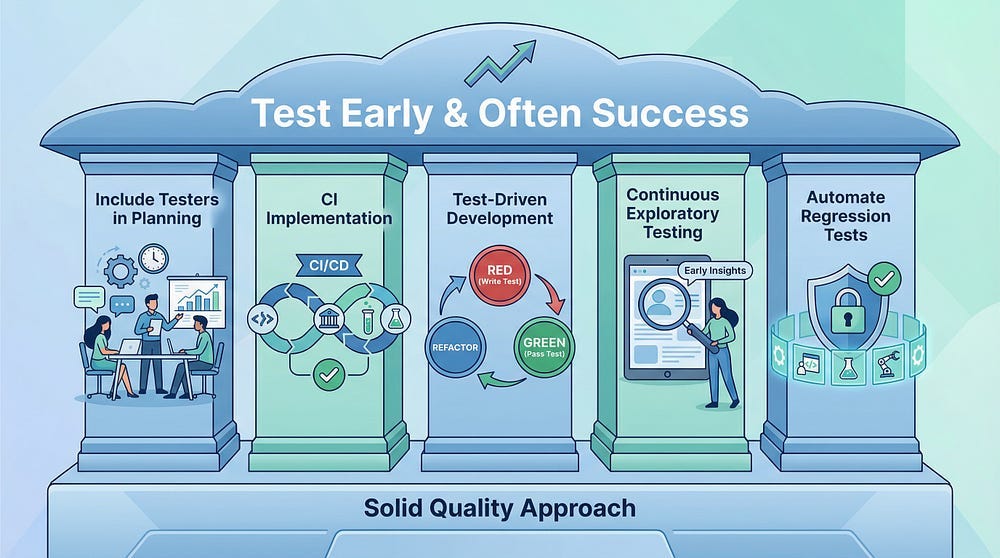
Practical Strategies for Testing Early and Often
Here’s how to actually implement this in your projects:
Strategy 1: Include Testers in Planning
How:
Invite testers to requirements meetings
Ask testers to review user stories before sprint planning
Have testers create acceptance criteria
Discuss testability during design reviews
Benefit: Catches issues before any code is written
Strategy 2: Implement Continuous Integration
How:
Set up automated builds on every code commit
Run unit tests automatically
Run integration tests in staging environment
Block merges if tests fail
Benefit: Immediate feedback, bugs caught within hours not weeks
Strategy 3: Practice Test-Driven Development
How:
Write test first describing desired behavior
Write minimal code to make test pass
Refactor while keeping tests passing
Repeat
Benefit: Code is automatically testable, design improves, confidence increases
Strategy 4: Do Continuous Exploratory Testing
How:
Testers access work-in-progress features
Explore new functionality as soon as it’s minimally usable
Report issues immediately (not waiting for “code complete”)
Quick feedback loop with developers
Benefit: Real-world usage insights while easy to change
Strategy 5: Automate Regression Tests
How:
Build test automation alongside features
Run automated tests frequently
Treat test code with same care as production code
Maintain and update tests continuously
Benefit: Confidence that changes don’t break existing functionality
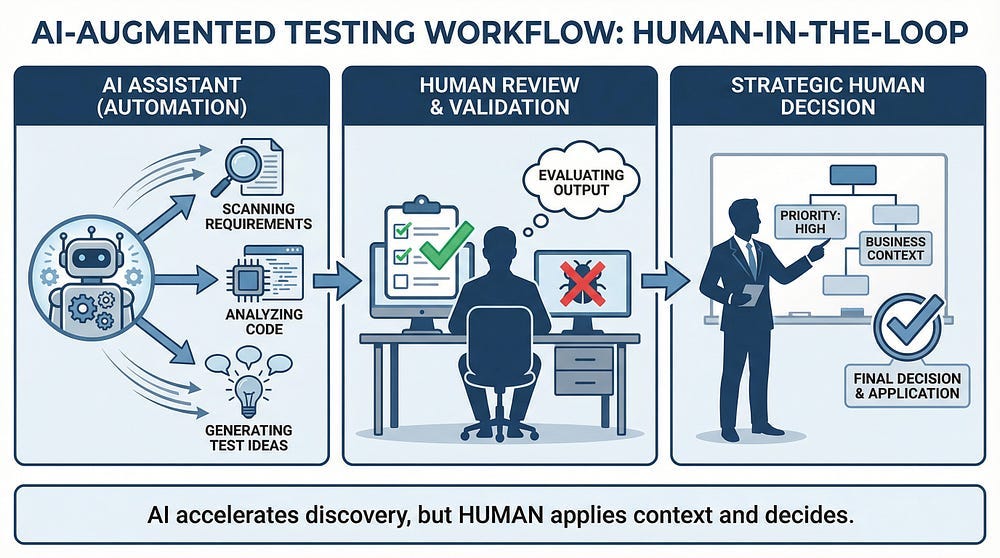
The Role of AI in Early Testing
AI tools are making early testing even more effective:
How AI Supports Early Testing
Requirements Analysis:
AI can scan requirements for ambiguity and incompleteness
Suggest test scenarios based on requirements
Identify contradictions or missing information
Test Case Generation:
Generate initial test cases early in the process
Suggest edge cases and error scenarios
Create test data automatically
Code Analysis:
Static analysis tools catch issues during development
AI suggests potential bugs before code is even run
Security vulnerability scanning
Continuous Monitoring:
AI analyzes production logs to predict potential issues
Identifies patterns that might indicate future problems
Proactive rather than reactive
But Remember: Trust But Verify
AI can accelerate early testing, but it has limitations:
AI can’t:
Understand business context and priorities
Evaluate requirements for business value
Determine what’s “good enough”
Replace human creativity in finding unusual scenarios
Your role:
Use AI to find obvious issues faster
Apply your expertise to evaluate AI suggestions
Focus your human effort on what AI misses
Make strategic decisions about risk and priority
Measuring the Impact of Early Testing
To prove the value of early testing in your organization, track these metrics:
Key Metrics to Track
1. Defect Detection Rate by Phase
How many bugs found in requirements vs design vs development vs testing vs production?
Goal: Shift the curve left over time
2. Cost Per Defect by Discovery Phase
How much does it cost to fix bugs found at different stages?
Shows the economic impact clearly
3. Escaped Defects
How many bugs reach production?
Target: Decrease over time as early testing improves
4. Time to Fix
How long from bug discovery to fix?
Earlier detection = faster fixes
5. Cycle Time
How long from feature start to production?
Early testing should decrease overall cycle time
6. Rework Percentage
What percentage of work is redoing/fixing vs new development?
Lower rework indicates better early testing
Before and After Comparison
Track metrics for 3 months before implementing early testing practices, then compare to 3 months after:
Example Results:
Defects found in requirements/design: 15% → 45%
Defects found in production: 12% → 3%
Average time to fix defect: 8 hours → 2 hours
Project timeline predictability: 60% → 90%
Team stress levels: High → Moderate
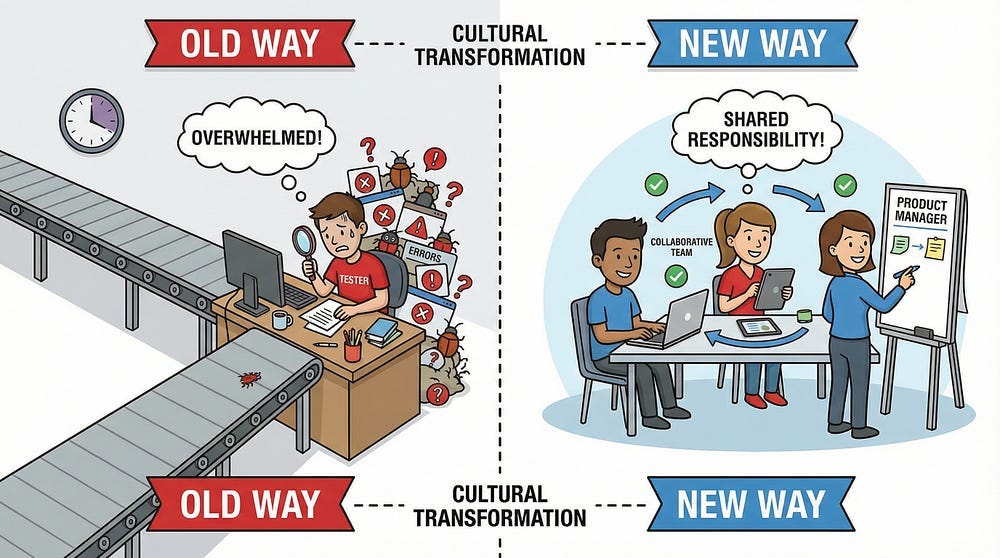
Cultural Shift Required
Implementing early and frequent testing isn’t just a process change — it requires a cultural shift:
From “Testing Phase” to “Testing Throughout”
Old mindset:
“Testing happens at the end”
“Testers test, developers develop”
“We’ll fix bugs later”
“Testing slows us down”
New mindset:
“Testing happens continuously”
“Quality is everyone’s responsibility”
“We fix bugs immediately”
“Testing speeds us up by preventing expensive late fixes”
Building the Culture
Leadership support:
Executives understand and communicate the economic benefits
Managers allocate time for early testing activities
Success is measured by quality, not just speed
Team collaboration:
Developers and testers work together, not in silos
Mutual respect for different perspectives
Shared ownership of quality
Process changes:
Testing is included in estimation and planning
Definition of Done includes testing
Code reviews are standard practice
Continuous integration is non-negotiable
Your Action Steps
This week, practice early testing thinking:
Review something early: Find a requirements document, design spec, or user story. Review it looking for ambiguities, missing scenarios, or testability issues. Document what you find.
Estimate the cost: Think of a bug you recently encountered. Estimate: when was it introduced, when was it found, and what would it have cost to fix at each phase in between?
Map your process: Draw your current development process. Where does testing happen? Identify opportunities to shift testing left.
Have a conversation: Talk to a developer about finding a bug earlier vs later. Share the cost multiplier concept. Get their perspective.
Track one metric: Choose one metric from the measuring section and start tracking it. You need baseline data to show improvement.
Moving Forward
Testing early and often isn’t just best practice — it’s economic necessity. The cost multipliers are real, the benefits are proven, and the competitive advantage is significant.
Every organization that embraces early testing experiences:
Lower costs
Faster delivery
Higher quality
Less stress
Happier customers
More satisfied teams
The question isn’t whether to test early — it’s how quickly you can shift your organization in that direction.
In our next article, we’ll explore Exhaustive Testing is Impossible — understanding why you can’t test everything and how to make strategic decisions about where to focus your testing efforts. This connects directly to today’s topic: since you can’t test everything, testing early ensures you catch the most important issues when they’re cheapest to fix.
Remember: Spending one hour on early testing saves ten hours—and thousands of dollars—fixing problems later.