
Building Your Testing Career Path
From junior tester to test architect

Nobody grows up dreaming of becoming a software tester.
Kids say they want to be astronauts, doctors, firefighters. College students target software engineering, product management, data science. Testing? Most people stumble into it sideways — a temporary stop that becomes a career when they realize they’re actually good at it.
And then comes the uncomfortable question: “What’s next?”
Because unlike development, where the path from junior developer to senior developer to architect to CTO feels well-worn, testing careers can feel like wandering through fog. You’re good at finding bugs. You’ve been good at finding bugs for three years. Now what?
I’ve watched testers plateau because they didn’t know paths existed. I’ve watched others leap ahead because they understood the landscape and moved intentionally. The difference wasn’t talent — it was awareness.
Today we’re mapping the territory. From your first testing role to the heights of test architecture and beyond, we’ll explore what each level demands, how to advance deliberately, and the different trajectories available depending on what you actually want from your career.
The Landscape Most Testers Don’t See
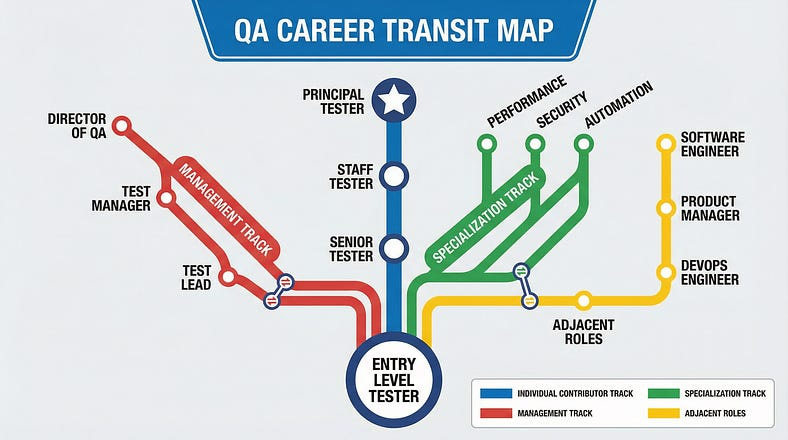
Here’s what nobody tells you when you start in testing: there are actually multiple career paths, and they lead to very different destinations.
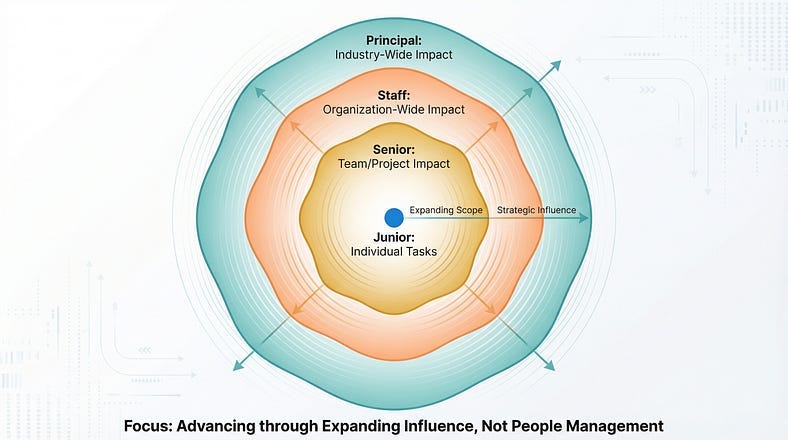
The Individual Contributor (IC) Track — You stay hands-on with testing, growing in scope and influence without managing people. Junior to Senior to Staff to Principal. Your expertise deepens, your impact broadens, but you’re still fundamentally doing testing work.
The Management Track — You shift from doing testing to leading testers. Test Lead to QA Manager to Director to VP of Quality. Your focus moves from finding bugs to building teams, processes, and quality culture.
The Specialization Track — You go deep in a specific testing domain. Performance engineering. Security testing. Automation architecture. Test infrastructure. You become the expert everyone consults for that specialty.
The Adjacent Track — You leverage testing experience to move into related roles. DevOps. Product management. Solutions engineering. Developer advocacy. Testing becomes the foundation for something else.
None of these paths is superior. They reward different strengths and satisfy different ambitions. The mistake is drifting without choosing — ending up somewhere by default rather than design.
Starting Out: The Junior Tester
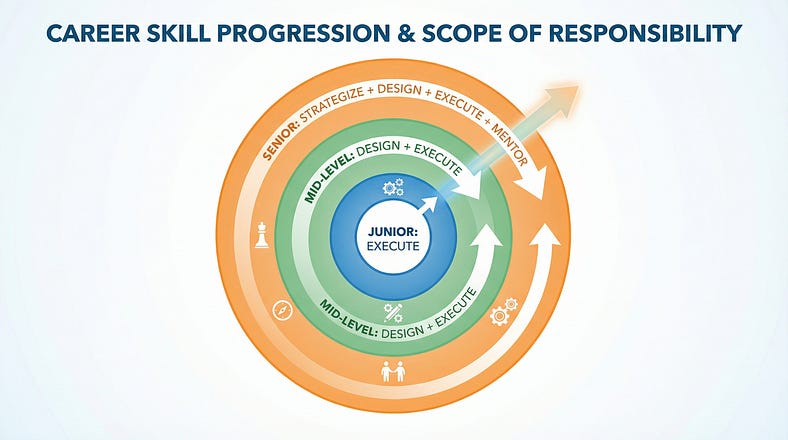
Every path starts here. You’re new to testing, learning the fundamentals, and figuring out whether this career fits you.
What’s expected of you:
Execute test cases reliably. Follow documented procedures. Report bugs clearly. Ask questions when you’re stuck. Learn the systems you’re testing. Absorb feedback without defensiveness.
You’re not expected to design test strategies or identify what’s missing from test coverage. You’re expected to do assigned work well and demonstrate you can be trusted with more.
What you should be learning:
Testing fundamentals — how to design test cases, how to think about coverage, how to write bug reports that developers actually want to read. Technical basics — enough about databases, APIs, and system architecture to understand what you’re testing. Domain knowledge — the business context that makes your testing meaningful.
You should also be learning how your organization works. Who decides what gets tested? How do bugs get prioritized? What does the release process look like? This organizational knowledge matters more than most juniors realize.
Common mistakes at this level:
Waiting to be told what to do instead of seeking work proactively. Not asking questions because you’re afraid of looking stupid. Focusing only on test execution without understanding why tests exist. Missing the big picture while drowning in details.
How to advance:
Demonstrate reliability first. Complete assigned work consistently and well. Then demonstrate initiative — find gaps in test coverage, suggest improvements, volunteer for challenging assignments. Show that you’re thinking beyond your current scope.
Most juniors stay at this level for one to two years. Some advance faster by being exceptional. Others linger longer because they’re content or because they haven’t demonstrated readiness for more responsibility.
Finding Your Footing: The Mid-Level Tester
You’ve proven you can execute. Now you need to prove you can think.
What’s expected of you:
Design test cases, not just execute them. Identify what should be tested for a feature without detailed guidance. Mentor junior testers. Participate meaningfully in planning discussions. Start contributing to test automation. Handle ambiguity without constant direction.
You’re no longer just following procedures — you’re helping create them.
What you should be learning:
Test design techniques in depth — equivalence partitioning, boundary analysis, state transitions, combinatorial testing. When to apply each and how to combine them. Automation skills — enough to write and maintain automated tests, even if you’re not building frameworks. Communication skills — how to influence without authority, how to deliver bad news constructively, how to advocate for quality.
This is also when you should start exploring what interests you. Does automation energize you? Does performance testing intrigue you? Do you enjoy mentoring others? These signals point toward future directions.
Common mistakes at this level:
Staying in execution mode when you should be in design mode. Avoiding automation because it’s uncomfortable. Not building relationships across teams. Failing to make your work visible to people who matter.
How to advance:
Take ownership of something. Maybe it’s a feature area, a type of testing, or an automation initiative. Own it completely — don’t wait for permission or assignment. Demonstrate that you can drive results without close supervision.
Also start developing others. Help juniors grow. Share knowledge. Your advancement increasingly depends on making the whole team better, not just being good individually.
Mid-level is where paths start diverging. Some testers stay here contentedly for years. Others begin pointing toward specialization, leadership, or advancement on the IC track.
Becoming a Force: The Senior Tester
Senior is where many testers aim to land. It’s a comfortable level — respected, well-compensated, and still hands-on. It’s also where many careers stall.
What’s expected of you:
Define test strategies for projects or product areas. Make coverage decisions that balance thoroughness with practicality. Lead testing efforts without formal authority. Mentor mid-level and junior testers effectively. Identify risks before they materialize. Communicate quality status to stakeholders clearly.
You’re the person others look to for testing decisions in your area.
What you should be learning:
Strategic thinking — how testing connects to business outcomes, how to prioritize based on risk and value, how to communicate with executives who don’t understand testing details. Technical depth in areas relevant to your work — if you test web applications, really understand browsers and protocols; if you test distributed systems, understand consistency and failure modes.
You should also be building your reputation beyond your immediate team. Write. Speak. Contribute to communities. Your career increasingly depends on being known, not just being good.
Common mistakes at this level:
Staying in your comfort zone instead of stretching into strategy and leadership. Hoarding knowledge instead of developing others. Avoiding organizational politics that affect your work. Not building external reputation.
How to advance:
This is where the paths really diverge, and you need to make intentional choices.
If you want the IC track toward Staff and Principal: Find ways to have impact beyond your immediate team. Solve problems that span multiple products or organizations. Become known for technical expertise that others depend on.
If you want management: Start taking on informal leadership. Coordinate work across people. Show that you can be responsible for team outcomes, not just individual outcomes.
If you want specialization: Go deep. Become the expert. Build reputation in your specialty area internally and externally.
The trap at Senior level is comfort. You’re good at your job. You’re well-paid. Things are fine. That comfort can become a cage if you’re not careful.
The Individual Contributor Heights: Staff and Principal
Beyond Senior on the IC track are levels that many testers don’t know exist: Staff and Principal (titles vary — some companies say “Lead” or “Distinguished” or “Fellow”).
These roles exist for individual contributors who have impact far beyond their immediate work — technical leaders who don’t manage people but shape how entire organizations approach testing.
Staff Tester
What’s expected of you:
Solve testing problems that span multiple teams or products. Define testing practices adopted across the organization. Be the person engineering leadership consults on quality strategy. Mentor senior testers toward staff level. Drive technical initiatives that change how testing works.
Your scope is organization-wide, not team-wide. You’re working on the testing approach itself, not just testing products.
What this looks like in practice:
Maybe you’re designing the automation architecture that all teams use. Maybe you’re defining the performance testing standards for the company. Maybe you’re building the test data management system that unblocks a dozen teams. Maybe you’re driving a cultural shift toward quality ownership.
Staff impact is measured in how you make others more effective, not just in your individual output.
Principal Tester
What’s expected of you:
Shape industry practices, not just organizational ones. Be recognized as an expert beyond your company. Solve problems nobody else has solved. Define the testing strategy for new technology or business areas. Influence engineering leadership at the highest levels.
Principal-level testers are rare. Many organizations don’t have the title or don’t know they need it. Principal testers are often confused with contractors or consultants because their work doesn’t fit normal molds.
What this looks like in practice:
Maybe you’re defining how your company approaches testing for AI systems when nobody has good answers. Maybe you’re representing your company’s quality perspective in industry standards bodies. Maybe you’re the person who gets called when an acquisition happens to figure out how to integrate testing organizations.
Principal is less a job and more a reputation. You reach it by being undeniably excellent over a sustained period.
The Management Track: Leading Testers
Not everyone wants to stay hands-on. Some testers discover they’re energized by building teams and developing people. The management track is for them.
Test Lead
The first step away from pure individual contribution. You’re still doing significant testing work, but you’re also coordinating work across a small group — maybe two to five testers.
You’re learning the basics: how to assign work fairly, how to run effective meetings, how to give feedback, how to shield your team from distractions, how to represent testing in cross-functional discussions.
Many organizations use “Test Lead” as a stepping stone to see if someone has management potential before committing to a full management role.
QA Manager
Now you’re managing testers. Your primary job shifts from testing to enabling testers to do their best work.
Hiring. Performance reviews. Career development. Team culture. Process improvement. Stakeholder management. Budget. Capacity planning.
You’re still close enough to the work to make technical decisions, but you’re spending most of your time on people and process, not on finding bugs yourself.
The hardest transition: letting go of being the best tester on the team. Your job isn’t to be the best tester — it’s to build a team of great testers. If you can’t let go of individual contribution, management will frustrate you.
Director of QA
You’re managing managers now — or managing a large enough team that you can’t have direct relationships with everyone.
Your focus shifts to strategy and organization design. How should testing be organized? What capabilities does the function need? How does quality strategy align with business strategy?
You’re representing quality at the leadership table, influencing decisions that affect the entire engineering organization. You need executive communication skills — the ability to translate testing concerns into business terms.
VP of Quality / Head of Quality
The summit of the management track in most organizations. You’re responsible for quality across the company — testing, but also broader quality culture, processes, and outcomes.
At this level, you’re less a testing expert and more a business leader who happens to focus on quality. You’re dealing with board presentations, M&A due diligence, organizational transformation, and strategic planning.
Very few testers reach this level. Those who do have typically been intentional about building business acumen and executive presence alongside their quality expertise.
The Specialization Track: Going Deep
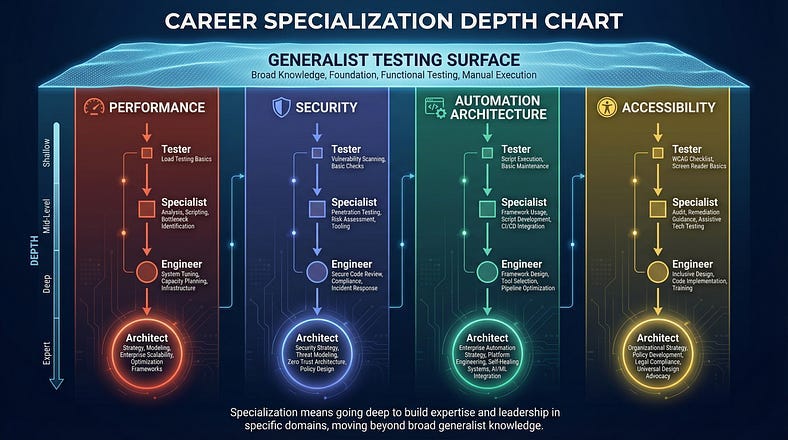
Some testers don’t want broader scope — they want deeper expertise. Specialization tracks let you become the undisputed expert in a specific domain.
Performance Engineering
You focus on how systems behave under load. Performance testing, load testing, stress testing, capacity planning, performance optimization.
This specialization requires strong technical skills — understanding of system architecture, profiling tools, database tuning, infrastructure. Performance engineers often have backgrounds in development or operations.
Career path: Performance Tester → Senior Performance Engineer → Performance Architect → Distinguished Performance Engineer.
The deep end of this specialization often involves application performance management (APM), site reliability engineering (SRE), or capacity planning roles that sit somewhere between testing and operations.
Security Testing
You focus on finding vulnerabilities before attackers do. Penetration testing, security assessments, threat modeling, security architecture review.
This specialization requires understanding of attack vectors, security tools, compliance frameworks, and the attacker mindset. Security testers often pursue certifications (OSCP, CEH) that validate their expertise.
Career path: Security Tester → Penetration Tester → Security Engineer → Security Architect → CISO.
Security is one of the few testing specializations with a clear path to executive level (Chief Information Security Officer), though that path involves much more than testing.
Automation Architecture
You focus on building the testing infrastructure that enables everyone else. Test frameworks, CI/CD pipeline integration, test data management, test environment orchestration.
This specialization requires strong development skills — you’re building software that tests software. Automation architects often have development backgrounds or develop those skills deeply in role.
Career path: Automation Engineer → Senior Automation Engineer → Automation Architect → Principal Engineer (Test Infrastructure).
The deep end of this specialization often converges with platform engineering or developer experience roles.
Accessibility Testing
You focus on ensuring software works for users with disabilities. WCAG compliance, assistive technology testing, inclusive design review.
This specialization requires understanding of accessibility standards, assistive technologies, and the diverse ways users interact with software. Deep empathy for users with disabilities is essential.
Career path: Accessibility Tester → Accessibility Specialist → Accessibility Lead → Director of Accessibility.
This specialization is growing as regulatory requirements increase and organizations recognize accessibility as both ethical imperative and business advantage.
The Adjacent Track: Leveraging Testing Experience
Testing experience opens doors to roles that aren’t testing but benefit enormously from testing background.
DevOps / Site Reliability Engineering
Testing teaches you to think about failure modes, edge cases, and system behavior under stress. DevOps and SRE roles need exactly that thinking applied to production systems.
Testers who move to DevOps bring quality thinking to operations — monitoring, alerting, deployment verification, incident response. The combination is powerful.
Product Management
Testing teaches you to understand user needs, identify what could go wrong, and evaluate whether software actually solves problems. Product managers need those same skills applied to product decisions.
Testers who move to product bring rigor to requirements, healthy skepticism about feature proposals, and deep understanding of what it takes to build quality software.
Solutions Engineering / Sales Engineering
Testing teaches you to understand software deeply and explain it clearly to non-technical audiences. Solutions engineers do exactly that — help customers understand how software solves their problems.
Testers who move to solutions engineering bring credibility (they really understand the product) and realistic expectations (they know what works and what doesn’t).
Developer Advocacy / Developer Relations
Testing teaches you to understand developer experience — what makes tools pleasant or frustrating to use. Developer advocates help external developers succeed with a company’s products.
Testers who move to developer advocacy bring the user empathy and clear communication skills that make technical content accessible.
Engineering Management
Some testers discover they want to lead engineers, not just testers. The transition from QA management to engineering management is possible, though it requires building technical credibility with developers.
Testing experience brings unique value to engineering management — quality thinking embedded in development leadership rather than separated from it.
Building Skills for Advancement
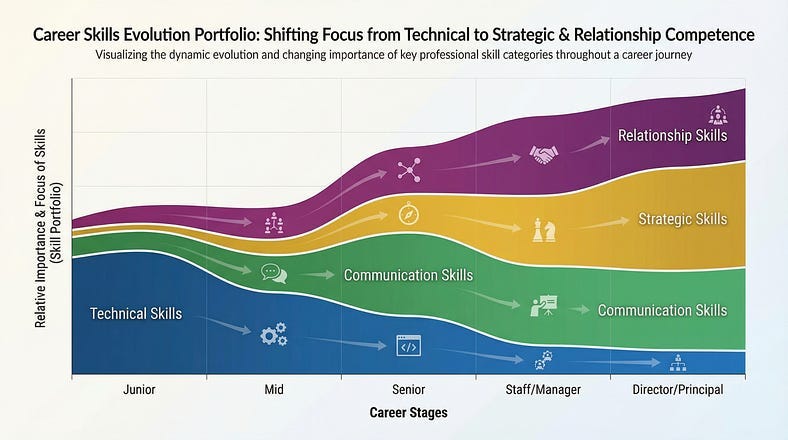
Regardless of which path you choose, certain skills become increasingly important as you advance.
Technical Skills That Scale
Early career: Learn tools and technologies specific to your current role.
Mid career: Learn principles that transfer across tools and technologies. Understanding HTTP matters more than mastering any particular API testing tool.
Late career: Learn to evaluate and adopt new technologies rapidly. The specific technologies will keep changing — your ability to learn and apply them matters more than any particular expertise.
Communication Skills
Early career: Write clear bug reports. Ask good questions.
Mid career: Explain testing concepts to non-testers. Deliver difficult feedback constructively. Present to stakeholders.
Late career: Communicate with executives in business terms. Influence without authority across organizational boundaries. Represent quality at the leadership table.
Communication skills compound. Every level demands more sophisticated communication than the last.
Strategic Thinking
Early career: Understand why tests exist, not just how to execute them.
Mid career: Design test strategies that balance coverage with practicality. Prioritize based on risk.
Late career: Connect testing strategy to business outcomes. Make investment decisions about quality capabilities. Shape organizational approach to quality.
Relationship Building
Early career: Build good working relationships with immediate teammates.
Mid career: Build relationships across teams. Know who to ask for help. Develop reputation within your organization.
Late career: Build relationships across the industry. Develop reputation externally. Know people who can open doors.
Relationships matter more than most technical people want to admit. Advancement increasingly depends on who knows you and trusts you.
The Moves That Accelerate Careers
Some career moves create disproportionate acceleration. These are the opportunities to seek out.
High-Visibility Projects
Projects that matter to leadership get attention. Success on visible projects creates reputation faster than quiet excellence on routine work. Seek them out, even if they’re riskier.
Organizational Change
When companies reorganize, grow rapidly, or face crises, normal career timelines compress. People get opportunities they wouldn’t get in stable times. Lean into change rather than avoiding it.
Stretch Assignments
Take assignments slightly beyond your current capability. Not so far beyond that you’ll fail, but far enough to force growth. The discomfort is the point.
External Reputation
Write articles. Speak at meetups and conferences. Contribute to open source. External reputation opens doors that internal reputation can’t. It also makes you more valuable internally — companies like employing recognized experts.
Mentorship (Both Directions)
Find mentors who can guide your development. Also mentor others — teaching forces you to understand things deeply and builds your reputation as a leader.
Strategic Job Changes
Sometimes the right move is leaving. Not job-hopping randomly, but strategic moves to organizations where you can grow faster, learn more, or access opportunities unavailable in your current role.
The testers who advance fastest combine excellent work with strategic positioning. Excellence alone isn’t enough — you need to be excellent at things that matter and make sure the right people know it.
Preparing for the AI-Transformed Landscape
Here’s a reality check: the testing career paths we’ve discussed are evolving as AI reshapes the field. The testers who thrive in the next decade will be those who adapt deliberately rather than react defensively.
What’s changing:
AI is automating the predictable parts of testing. Test case generation. Routine regression execution. Basic bug detection. The tasks that filled junior tester schedules five years ago are increasingly handled by machines.
This isn’t a threat — it’s a shift. The work isn’t disappearing. It’s elevating.
What this means for each career stage:
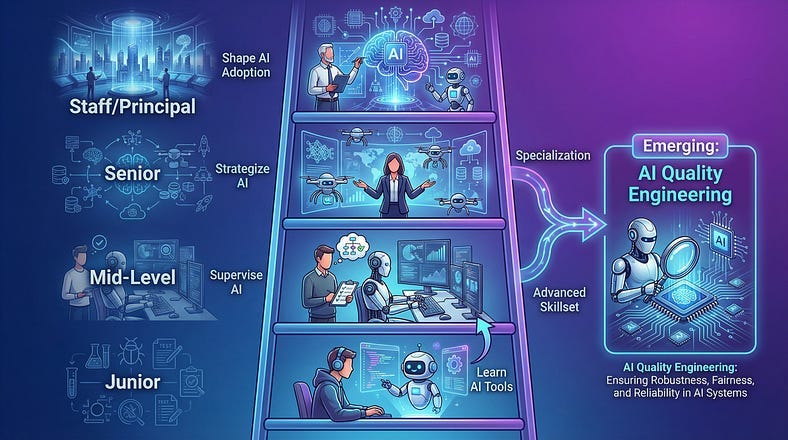
Junior testers need to learn AI tools from day one. Not just how to use them, but how to evaluate their output. AI generates test cases — but are they the right test cases? AI flags potential bugs — but are they real? The junior skill set now includes AI collaboration alongside traditional fundamentals.
Mid-level testers become AI supervisors. You’re designing prompts, curating AI-generated tests, and catching what AI misses. You’re also identifying where AI adds value versus where human judgment remains essential. This discernment becomes a core competency.
Senior testers define AI testing strategy. Which workflows benefit from AI? Where does automation make sense versus human exploration? How do you maintain quality when AI accelerates development velocity? Strategic thinking now includes AI integration decisions.
Staff and Principal levels shape how organizations adopt AI in testing. You’re evaluating tools, defining governance, building frameworks for AI-assisted quality. You’re also tackling the novel challenge of testing AI systems themselves — a specialization that barely existed five years ago.
New specialization emerging: AI Quality Engineering
Testing AI systems is fundamentally different from testing traditional software. Outputs are probabilistic, not deterministic. Edge cases are infinite. “Correct” behavior is often subjective.
This specialization requires understanding of machine learning concepts, prompt engineering, bias detection, and evaluation methodologies that are still being invented. Testers who develop expertise here are positioning themselves for roles that don’t fully exist yet — but will.
The skills that AI can’t replace:
Judgment about what matters. Empathy for user experience. Skepticism about whether something actually works. Creative exploration of unexpected scenarios. Communication that turns findings into action.
These human skills become more valuable, not less, as AI handles routine work.
Your AI readiness checklist:
Are you using AI tools in your current testing work? Do you understand their limitations? Can you evaluate AI-generated test cases critically? Have you tested an AI-powered feature? Do you understand basic concepts like training data, hallucination, and prompt design?
If you answered no to most of these, you have gaps to close.
The testers who ignore AI will find their skills commoditized. The testers who embrace AI thoughtfully will find their impact multiplied.
Choose deliberately.
The Plateau Problem
Let’s talk about what happens when careers stall.
Many testers hit a plateau around Senior level. They’re good at their jobs. They’re comfortable. And they stop growing.
Sometimes this is intentional — not everyone wants to keep climbing. A satisfying career at a level you enjoy is a valid choice.
But often it’s unintentional. Testers don’t realize they’ve stopped growing until they try to change jobs and discover their skills haven’t kept pace with the market.
Signs you’re plateauing:
You haven’t learned anything significant in the past year. Your responsibilities haven’t increased. You’re doing the same work you did two years ago. You’re not being considered for advancement. You’re comfortable.
How to break a plateau:
Change something. Take on a new challenge in your current role. Move to a different team or company. Learn a new skill. Pursue a specialization. Volunteer for the project nobody wants.
Plateaus are broken by discomfort. If you’re comfortable, you’re probably not growing.
Making Your Choice
You’ve seen the landscape. Now you need to choose a direction.
Ask yourself:
Do you want to stay hands-on with testing? The IC track keeps you close to the work while expanding your scope and influence.
Do you want to build and lead teams? The management track shifts your focus from doing testing to enabling testers.
Do you want to be the undisputed expert in something? Specialization tracks let you go deeper than generalists can.
Do you want to leverage testing into something else? Adjacent tracks use your testing foundation for different career destinations.
There’s no wrong answer — only answers that fit or don’t fit what you actually want.
And you can change your mind. Paths aren’t permanent. Staff engineers become managers. Managers return to IC roles. Specialists broaden out. Career paths are more like climbing walls than ladders — you can move in multiple directions.
Your Career Planning Exercise
Don’t just read this article — do something with it.
Step 1: Assess your current position. Where are you in the landscape? What level? What path are you on by default?
Step 2: Define your target. Where do you want to be in three years? Five years? Which path attracts you most?
Step 3: Identify the gaps. What skills does your target require that you don’t have today? What experiences are you missing?
Step 4: Make a plan. How will you close those gaps? What will you do in the next six months? Be specific.
Step 5: Take one action this week. Not someday. This week. One concrete step toward your career goal.
Your career won’t build itself. Waiting to be noticed is not a strategy. Hoping for promotion is not a plan.
Be intentional. Make choices. Take action.
Your Career, Your Responsibility
The testing career path isn’t as clearly marked as development paths. That’s frustrating, but it’s also freeing. You have more room to define your own trajectory.
The testers who build great careers share a common trait: they take responsibility for their own development. They don’t wait for their company to invest in them. They don’t expect promotions to happen automatically. They identify where they want to go and work deliberately to get there.
Paths from junior tester to test architect exist. Paths to management exist. Paths to specialization exist. Paths to adjacent roles exist.
But nobody will walk those paths for you.
In our next article, we’ll explore Introduction to Manual Testing — understanding when human judgment is irreplaceable. In a world racing toward automation and AI, we’ll examine why manual testing remains essential, what humans catch that machines miss, and how to apply manual testing strategically rather than as a default.
Remember: Career paths exist. Most testers just don’t know about them. Now you do. What will you do with that knowledge?